The Atlas
Barangays in Negros Occidental
The barangay is the smallest local government: where the government's plans and services reach the community, and where neighbours settle disputes.[1] A punong barangay, often called the kapitan, leads it with seven elected kagawad and the chairperson of the Sangguniang Kabataan.[1]
A barangay is created by law or by an ordinance of its province or city, and only when its voters approve it in a plebiscite. It needs at least 2,000 people, or 5,000 in Metro Manila and the highly urbanized cities.[1]
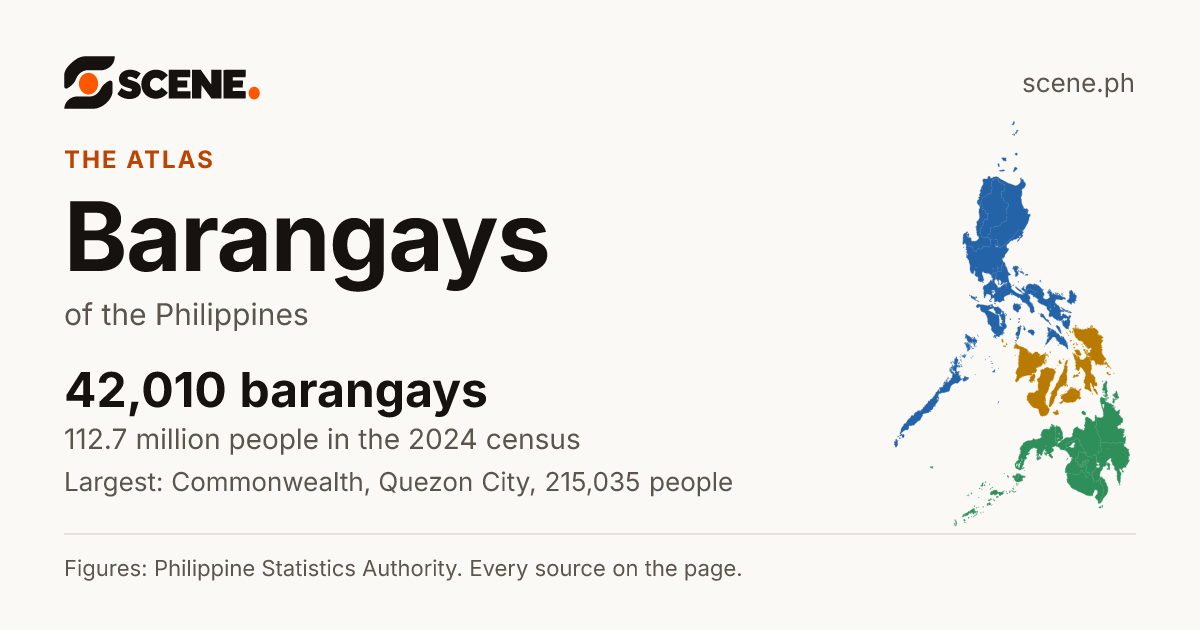
This is how the link shows on Facebook, Messenger, Viber, WhatsApp and X.
Or share on
- Share on Facebook (opens in a new tab)
- Share on WhatsApp (opens in a new tab)
- Share on Viber (opens the Viber app)
- Share on X (opens in a new tab)
- Share on Telegram (opens in a new tab)
- Share on Threads (opens in a new tab)
- Share on LINE (opens in a new tab)
- Share on LinkedIn (opens in a new tab)
- Share on Reddit (opens in a new tab)
- Share on Pinterest (opens in a new tab)
- Share on Bluesky (opens in a new tab)
- Share on Tumblr (opens in a new tab)
- Share by SMS (opens your messages app)
- Share by Email
Viber opens the Viber app on this device. Without it, copy the link above.
Barangays in Negros Occidental, at a glance
- Barangays
- 662[2]
- People, 2024CensusA count of every person in the country, all on one day. The 2024 census counted people as they were on 1 July 2024.More in the glossary
- 3,305,264[3]
- Urban or ruralUrban barangayThe PSA counts a barangay as urban when it has 5,000 people or more, or a big employer, or several businesses and public services close by. Every barangay in Metro Manila is urban.More in the glossary
- 301 urban[4]
- 361 rural, as the PSA classes each barangay.
- Largest by landLand areaThe land inside the place's official boundary. A square kilometre is a square 1 km on each side, about the size of 140 football fields.More in the glossary
- Gatuslao[6]
- Candoni, Negros Occidental
- about 152.99 km²
- Fastest growing, 5,000 people or moreGrowth a yearHow fast the number of people changed each year between two censuses. 1% a year means about 1 more person for every 100 people, each year.More in the glossary
- San Rafael[5, 7]
- Hinoba-an, Negros Occidental
- 12.72% a year, 2020 to 2024
- Fewer people than in 2020Growth a yearHow fast the number of people changed each year between two censuses. 1% a year means about 1 more person for every 100 people, each year.More in the glossary
- 231 barangays[7]
- Of those with 5,000 people or more, the steepest fall: Rafaela Barrera, −4.89% a year.
Province: Negros Occidental
Town: All
- All
- Bacolod City
- Bago City
- Binalbagan
- Cadiz City
- Calatrava
- Candoni
- Cauayan
- Enrique B. Magalona
- Escalante City
- Himamaylan City
- Hinigaran
- Hinoba-an
- Ilog
- Isabela
- Kabankalan City
- La Carlota City
- La Castellana
- Manapla
- Moises Padilla
- Murcia
- Pontevedra
- Pulupandan
- Sagay City
- Salvador Benedicto
- San Carlos City
- San Enrique
- Silay City
- Sipalay City
- Talisay City
- Toboso
- Valladolid
- Victorias City
Sort: Most people
Each row is a barangay, with its 2024 census figures. Choose a column heading or a sort button to order the list, and choose it again to turn the order round. Narrow it with the menus.
662 barangays, 301 to 350 shown, most people first.
| Rank | Name | People, 2024 | People per km² | Area | Growth, 2020–2024 | Urban or rural |
|---|---|---|---|---|---|---|
| 301 | Crossing MagallonMoises Padilla, Negros Occidental | 3,717 | about 261 | about 14.26 km² | −2.75% a year | Rural |
| 302 | Poblacion EastCandoni, Negros Occidental | 3,710 | about 339 | about 10.93 km² | −0.12% a year | Rural |
| 303 | BagumbayanValladolid, Negros Occidental | 3,680 | about 4,196 | about 0.877 km² | 0.56% a year | Rural |
| 304 | PatagSilay City, Negros Occidental | 3,671 | about 81 | about 45.25 km² | 1.53% a year | Rural |
| 305 | CayhaganSipalay City, Negros Occidental | 3,654 | about 509 | about 7.18 km² | −0.31% a year | Rural |
| 306 | Po-okHinoba-an, Negros Occidental | 3,639 | about 222 | about 16.37 km² | 4.60% a year | Rural |
| 307 | TabigueEnrique B. Magalona, Negros Occidental | 3,639 | about 1,323 | about 2.75 km² | −0.46% a year | Rural |
| 308 | San AgustinIsabela, Negros Occidental | 3,624 | about 315 | about 11.52 km² | 0.15% a year | Rural |
| 309 | CervantesEscalante City, Negros Occidental | 3,609 | about 581 | about 6.21 km² | 2.54% a year | Rural |
| 310 | General LunaSagay City, Negros Occidental | 3,602 | about 264 | about 13.65 km² | 0.69% a year | Rural |
| 311 | PoblacionValladolid, Negros Occidental | 3,599 | about 7,467 | about 0.482 km² | −0.13% a year | Rural |
| 312 | Guinpana-anMoises Padilla, Negros Occidental | 3,579 | about 475 | about 7.54 km² | 0.88% a year | Rural |
| 313 | Barangay 2Bacolod City, Negros Occidental | 3,567 | about 29,000 | about 0.123 km² | 2.06% a year | Urban |
| 314 | Barangay ILa Carlota City, Negros Occidental | 3,567 | about 3,102 | about 1.15 km² | −1.98% a year | Urban |
| 315 | Nabali-anHimamaylan City, Negros Occidental | 3,566 | about 339 | about 10.53 km² | 0.37% a year | Rural |
| 316 | Celestino VillacinCadiz City, Negros Occidental | 3,555 | about 25 | about 142.35 km² | 0.70% a year | Rural |
| 317 | PinggotIlog, Negros Occidental | 3,555 | about 34 | about 105.13 km² | 1.41% a year | Rural |
| 318 | BasakCauayan, Negros Occidental | 3,552 | about 165 | about 21.49 km² | −0.33% a year | Rural |
| 319 | CanromaPontevedra, Negros Occidental | 3,541 | about 625 | about 5.67 km² | 1.75% a year | Rural |
| 320 | Central TabaoValladolid, Negros Occidental | 3,540 | about 6,265 | about 0.565 km² | 0.43% a year | Rural |
| 321 | IlijanBago City, Negros Occidental | 3,531 | about 78 | about 45.53 km² | 0.09% a year | Rural |
| 322 | PandanonMurcia, Negros Occidental | 3,495 | about 549 | about 6.37 km² | 3.89% a year | Rural |
| 323 | AlegriaMurcia, Negros Occidental | 3,477 | about 383 | about 9.09 km² | −2.06% a year | Urban |
| 324 | BandilaToboso, Negros Occidental | 3,476 | about 181 | about 19.17 km² | 4.78% a year | Rural |
| 325 | PandanPontevedra, Negros Occidental | 3,470 | about 397 | about 8.74 km² | 0.56% a year | Rural |
| 326 | NagasiLa Carlota City, Negros Occidental | 3,438 | about 397 | about 8.65 km² | −0.15% a year | Rural |
| 327 | CansalongonIsabela, Negros Occidental | 3,406 | about 474 | about 7.18 km² | −0.38% a year | Rural |
| 328 | PinapugasanEscalante City, Negros Occidental | 3,399 | about 268 | about 12.68 km² | −0.87% a year | Rural |
| 329 | Camba-ogHinigaran, Negros Occidental | 3,387 | about 654 | about 5.18 km² | 0.82% a year | Rural |
| 330 | Sagua BanuaValladolid, Negros Occidental | 3,370 | about 2,324 | about 1.45 km² | −0.06% a year | Urban |
| 331 | Bagong SilangSalvador Benedicto, Negros Occidental | 3,362 | about 56 | about 59.94 km² | 4.75% a year | Rural |
| 332 | ArandaHinigaran, Negros Occidental | 3,358 | about 285 | about 11.78 km² | 2.54% a year | Rural |
| 333 | Santo RosarioBinalbagan, Negros Occidental | 3,352 | about 2,163 | about 1.55 km² | −1.78% a year | Urban |
| 334 | BubogTalisay City, Negros Occidental | 3,350 | about 609 | about 5.50 km² | 1.13% a year | Urban |
| 335 | GuintubhanIsabela, Negros Occidental | 3,345 | about 382 | about 8.76 km² | 0.86% a year | Rural |
| 336 | BatoHinigaran, Negros Occidental | 3,338 | about 467 | about 7.15 km² | 0.69% a year | Rural |
| 337 | NancaEnrique B. Magalona, Negros Occidental | 3,310 | about 476 | about 6.95 km² | −0.68% a year | Rural |
| 338 | San IsidroEnrique B. Magalona, Negros Occidental | 3,307 | about 159 | about 20.81 km² | 0.14% a year | Rural |
| 339 | Barangay 6Kabankalan City, Negros Occidental | 3,306 | about 3,437 | about 0.962 km² | 1.67% a year | Rural |
| 340 | BuladIsabela, Negros Occidental | 3,306 | about 216 | about 15.34 km² | 2.27% a year | Urban |
| 341 | Barangay IIIlog, Negros Occidental | 3,293 | about 224 | about 14.69 km² | 0.42% a year | Rural |
| 342 | Barangay IHinigaran, Negros Occidental | 3,291 | about 18,914 | about 0.174 km² | −0.37% a year | Urban |
| 343 | HimayaHinigaran, Negros Occidental | 3,289 | about 277 | about 11.89 km² | −0.25% a year | Rural |
| 344 | TadlongSagay City, Negros Occidental | 3,286 | about 346 | about 9.51 km² | 1.07% a year | Rural |
| 345 | Vista AlegreIlog, Negros Occidental | 3,267 | about 525 | about 6.22 km² | 0.28% a year | Rural |
| 346 | MalasibogEscalante City, Negros Occidental | 3,254 | about 347 | about 9.38 km² | 1.22% a year | Rural |
| 347 | CalibanMurcia, Negros Occidental | 3,241 | about 511 | about 6.34 km² | 1.48% a year | Rural |
| 348 | PalakaValladolid, Negros Occidental | 3,210 | about 1,378 | about 2.33 km² | 0.04% a year | Rural |
| 349 | San IsidroCalatrava, Negros Occidental | 3,203 | about 671 | about 4.77 km² | 0.88% a year | Rural |
| 350 | Barangay IIHinoba-an, Negros Occidental | 3,195 | about 1,614 | about 1.98 km² | −1.86% a year | Rural |
How it fits
A barangay is the smallest unit of government, led by a punong barangay (the kapitan) and a council of kagawad. Every city and municipality is made up of barangays.
Sources
The list shows each place's own figures: people from the PSA's 2024 census, growth from its 2020 census, land areas from the Land Management Bureau's 2019 masterlist. A barangay's area is measured inside its border on UN OCHA's map and is approximate, and a barangay shows no growth where its border changed after 2020. Every figure's source is on its place's page; how Scene works out the rest.
- 1.Congress of the Philippines. Republic Act No. 7160: the Local Government Code of 1991. Published October 10, 1991. Read by Scene October 2, 2026. Philippine government work, no copyright (Republic Act No. 8293, Section 176.1). Open the source
- 2.Philippine Statistics Authority. Philippine Standard Geographic Code (PSGC), 2nd Quarter 2026: Publication Datafile. Published June 30, 2026. Read by Scene September 24, 2026. CC BY (PSA Terms of Use). Open the source
- 3.Philippine Statistics Authority. Population and Annual Population Growth Rate of the Philippines and its Regions, Provinces, and Highly Urbanized Cities Based on the 2010, 2015, 2020 and 2024 Population Census (OpenSTAT table 0211A6DAPG0). Published August 7, 2026. Read by Scene October 2, 2026. CC BY (PSA Terms of Use). Open the source
- 4.Philippine Statistics Authority. Total Population and Urban Population by Urban Classification and Region, Province, Highly Urbanized City, City/Municipality and Barangay: Philippines, 2024 (OpenSTAT table 0231A6DPUP0). Published August 7, 2026. Read by Scene October 2, 2026. CC BY (PSA Terms of Use). Open the source
- 5.Philippine Statistics Authority. Total Population, Household Population, and Number of Households by Province, City, Municipality, and Barangay as of 01 July 2024: Negros Island Region (NIR) (OpenSTAT table 0181A6DTHP7). Published August 7, 2026. Read by Scene October 2, 2026. CC BY (PSA Terms of Use). Open the source
- 6.UN OCHA, from the PSA and NAMRIA. Philippines: Subnational Administrative Boundaries (COD-AB), barangay layer. Published February 13, 2025. Read by Scene September 25, 2026. CC BY-IGO 3.0. Open the source
- 7.Philippine Statistics Authority. Philippine Standard Geographic Code (PSGC), 4th Quarter 2022: Publication Datafile, with the 2015 and 2020 census counts (the PSA's file, as the Internet Archive keeps it). Published December 31, 2022. Read by Scene October 2, 2026. CC BY (PSA Terms of Use). Open the source
Scene adds what the sources do not print themselves: growth rates, shares, barangay areas and densities, coordinates, neighbours and distances, each computed from the figures and borders above. How each is made.
See something wrong on this page? Write to hello@scene.ph with the page address. We check every report against the source.